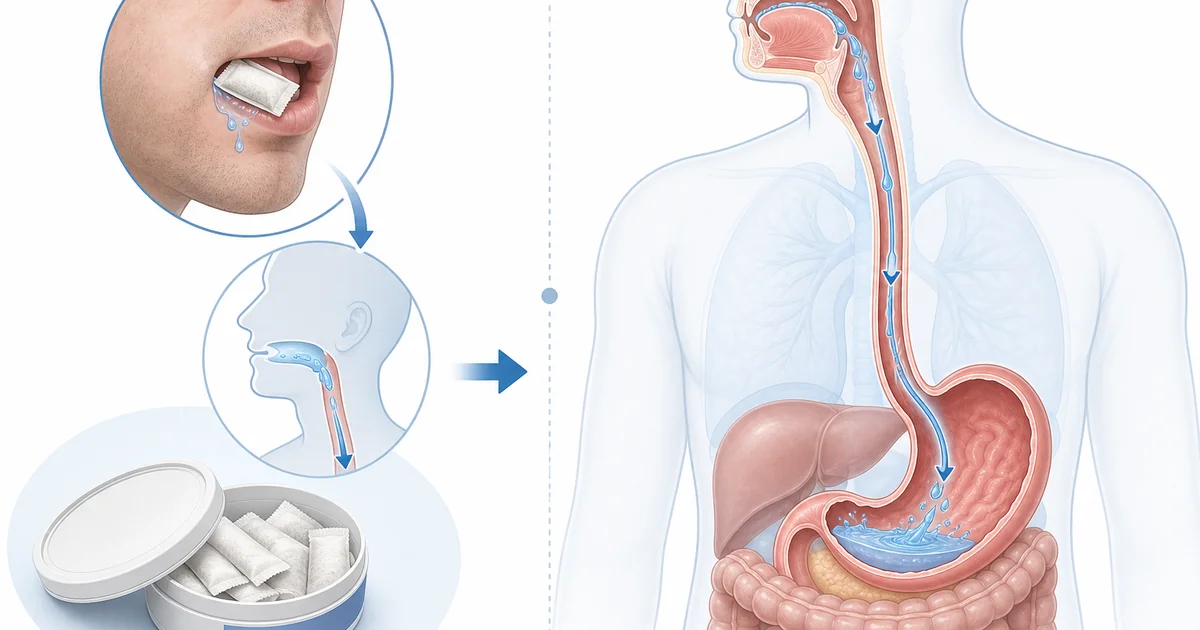
Nicotine pouches are marketed as "spitless," which sounds clean and convenient. But here is what that actually means: you are not spitting because you are swallowing the saliva instead. Your body absorbs some nicotine through your gum, and the rest goes down your throat with every swallow. The question is not whether you can swallow ZYN spit. It is whether you should, and what it does to you over time.
What "Spitless" Actually Means
The marketing makes it sound like nicotine pouches produce no saliva at all. That is not true. Your mouth still produces saliva when you have a pouch in. The difference between a pouch and traditional smokeless tobacco is that you do not need to spit. With chewing tobacco or snus, the tobacco leaf breaks down and creates a messy liquid that you cannot swallow. Nicotine pouches are dry and contained, so the saliva you produce is just your normal saliva mixed with dissolved nicotine.
The companies know this sounds better than "you will be swallowing nicotine-laced spit all day." Spitless is technically accurate. It is also technically misleading if you do not understand what is happening in your mouth.
What Happens When You Swallow ZYN Saliva
Your stomach acid breaks down most of the nicotine you swallow. That is why swallowing a small amount of pouch saliva usually does not cause immediate problems. Your digestive system treats it like any other irritant and processes it out.
But "usually" is doing a lot of work there. The more pouches you use, the more nicotine you swallow. Heavy users report nausea, stomach cramps, and general digestive discomfort. The flavorings and additives in the pouches do not help. Your gut was not designed to process mint oil, coffee flavoring, or whatever chemical creates that "chill" sensation in your mouth.
Nicotine also affects your digestive system directly. It increases stomach acid production and can irritate the lining of your stomach. If you already deal with acid reflux or ulcers, swallowing pouch saliva all day is probably making it worse.
The Hidden Problem: Dry Mouth
Here is the counterintuitive part. Nicotine pouches reduce your saliva production over time. Nicotine is a vasoconstrictor, which means it narrows blood vessels and reduces blood flow to your salivary glands. Less blood flow means less saliva.
So you are swallowing nicotine-laced saliva while simultaneously producing less of the protective saliva your mouth needs. Saliva neutralizes acids, washes away bacteria, and protects your tooth enamel. Chronic dry mouth leads to cavities, gum disease, and bad breath. The "spitless" convenience comes with a dental bill down the road.
Dentists have started noticing this pattern. Patients who switch from smoking to pouches often show up with worse oral health than expected. They think they have made a healthier choice, and in some ways they have. Their lungs are better off. But their mouths are paying a different price.
Why the Swallowing Adds Up
A typical ZYN pouch delivers nicotine for 20 to 40 minutes. Most users keep a pouch in for the full duration and swallow normally the entire time. If you use 8 to 12 pouches per day, which is common for regular users, you are swallowing concentrated nicotine saliva dozens of times daily.
Compare that to smoking. When you smoke, you absorb nicotine through your lungs and exhale most of the byproducts. When you vape, you absorb through your lungs and exhale vapor. With pouches, you absorb some through your gum and swallow the rest. Your digestive system and liver end up processing way more nicotine than they would with other methods.
Your liver metabolizes nicotine into cotinine. This process creates oxidative stress and uses up resources your body needs for other functions. Heavy pouch users often have higher cotinine levels than smokers, which suggests their total nicotine exposure is actually higher despite the "cleaner" delivery method.
What Heavy Users Report
I have talked to people who went through a can of pouches per day. The pattern is consistent. They start with occasional use, maybe one or two pouches during work hours. Over months, the frequency creeps up. They keep a pouch in while driving, while working, while watching TV at night. The can empties faster and faster.
The physical symptoms show up gradually. Stomach issues are the most common complaint. Nausea, cramping, a general feeling that something is off with their digestion. Some develop persistent heartburn. Others notice their mouth feels constantly dry, no matter how much water they drink.
The mental dependence is harder to spot. They feel antsy without a pouch in. Meetings feel longer. Social situations feel more awkward. The pouch becomes a security object, something they reach for without thinking. The swallowing becomes automatic too. They do not even notice they are doing it anymore.
The Marketing vs. The Reality
The tobacco companies want you to think of pouches as a clean, modern alternative to smoking. The packaging looks like mint tins or tech accessories. The flavors sound like boutique coffee shop offerings. The "spitless" claim implies you are not really using tobacco at all.
But you are still consuming nicotine, which is one of the most addictive substances available. You are still developing a physical dependence. You are still spending money on a habit that controls your behavior. The only difference is the delivery mechanism and the specific health risks you are trading for.
Smoking damages your lungs. Pouches damage your gums, teeth, and digestive system. Neither is good for your cardiovascular health. Neither is good for your wallet or your freedom. The "spitless" feature is a convenience, not a health benefit.
What Happens When You Quit
If you are reading this while trying to quit, you probably want to know what to expect. The first three days are the hardest. Your body is used to regular nicotine hits, and it will complain loudly when they stop. Irritability, headaches, difficulty concentrating, and intense cravings are normal.
The digestive issues often get worse before they get better. Your gut has adapted to processing nicotine constantly. When that stops, your stomach may feel unsettled for a week or two. This passes. Your salivary glands will start working normally again, and the dry mouth will improve.
Most people find the mental dependence harder to break than the physical one. The habit of reaching for a pouch is deeply ingrained. You have probably associated specific activities with pouch use: driving, working, socializing. Those associations do not disappear just because the nicotine leaves your system.
Practical Strategies for Quitting
If you want to stop, start by tracking your actual usage. Most people underestimate how many pouches they use per day. Write it down for a week. The number might surprise you.
Set a quit date and tell people about it. Accountability helps. Remove pouches from your environment before that date. Do not keep a "just in case" stash. You will use it.
Replace the oral habit with something else. Sugar-free gum, mints, or even a water bottle you sip from constantly. The physical sensation of having something in your mouth is part of the addiction. Give your mouth an alternative.
Expect the cravings to come in waves. They peak at around 20 minutes and usually pass within an hour. When a craving hits, do something that occupies your hands and mouth. Go for a walk. Call someone. Clean something. The craving will pass whether you use a pouch or not.
FAQ
Is swallowing ZYN spit dangerous?
Swallowing small amounts of pouch saliva is not immediately dangerous for most people. Your stomach acid breaks down the nicotine. However, heavy users who swallow concentrated nicotine saliva repeatedly throughout the day often experience nausea, stomach cramps, and digestive issues. The long-term effects of chronic nicotine ingestion through the digestive system are still being studied.
Why do nicotine pouches make my mouth dry?
Nicotine is a vasoconstrictor that reduces blood flow to your salivary glands, which decreases saliva production. This dry mouth effect is common among pouch users and can lead to dental problems over time because saliva normally protects your teeth and gums from bacteria and acid.
Do I absorb more nicotine from pouches than from cigarettes?
Many pouch users end up with higher total nicotine exposure than smokers because they keep pouches in for hours at a time and use them continuously throughout the day. While cigarettes deliver nicotine faster through the lungs, the steady absorption from pouches plus the swallowed nicotine can result in higher overall levels.
Can swallowing ZYN spit cause stomach ulcers?
Nicotine increases stomach acid production and can irritate the stomach lining. While swallowing pouch saliva alone is unlikely to cause ulcers in healthy people, it can worsen existing digestive issues or contribute to acid reflux. If you have a history of ulcers or GERD, the additional nicotine exposure from swallowed saliva may aggravate your condition.
Is it better to spit or swallow with nicotine pouches?
Spitting would reduce your nicotine exposure, but pouches are designed to be used without spitting. If you are concerned about the effects of swallowing nicotine saliva, the better solution is to reduce your overall pouch use or quit entirely rather than trying to spit around a product designed for swallowing.
How long does nicotine stay in your system from pouches?
Nicotine from pouches stays in your system for about 3 to 4 days, similar to other nicotine products. However, heavy pouch users often have higher cotinine levels than smokers because of the continuous absorption plus the swallowed nicotine. Cotinine, the metabolite that drug tests detect, can be present for up to 10 days in heavy users.
Does swallowing ZYN spit affect drug tests?
Swallowing pouch saliva does not change whether nicotine shows up on a drug test. The nicotine is already in your system from absorption through your gum. Standard drug tests do not screen for nicotine anyway. Only specialized tests for nicotine or cotinine will detect pouch use, and those are typically used for insurance or medical purposes, not employment screening.
Why do I feel nauseous after using ZYN?
Nausea is a common side effect of nicotine, especially for new users or people who swallow a lot of pouch saliva. Your stomach is reacting to the nicotine and the additives in the pouch. If nausea persists, try reducing your usage or switching to lower-strength pouches. Persistent nausea is a sign your body is not tolerating the product well.
How do I quit nicotine pouches for good?
Start by tracking your usage to understand your actual consumption. Set a quit date and remove all pouches from your environment. Use replacement strategies like gum or mints for the oral habit. Expect cravings to peak at 20 minutes and pass within an hour. Consider using a quit app like PouchOut to track progress and manage withdrawal symptoms. Most people find the mental habit harder to break than the physical dependence, so be patient with yourself.
Related Articles
- How to Quit ZYN: Complete 2026 Guide
- Nicotine Pouch Withdrawal Timeline: Day by Day
- ZYN Side Effects: What to Expect
- Quitting ZYN Without Withdrawal Symptoms
- How to Quit VELO
- How to Quit On!
- How to Quit Lyft
- Reasons to Quit ZYN: Motivation Guide
- ZYN and Anxiety: The Connection
- Sleep and Nicotine: What You Need to Know