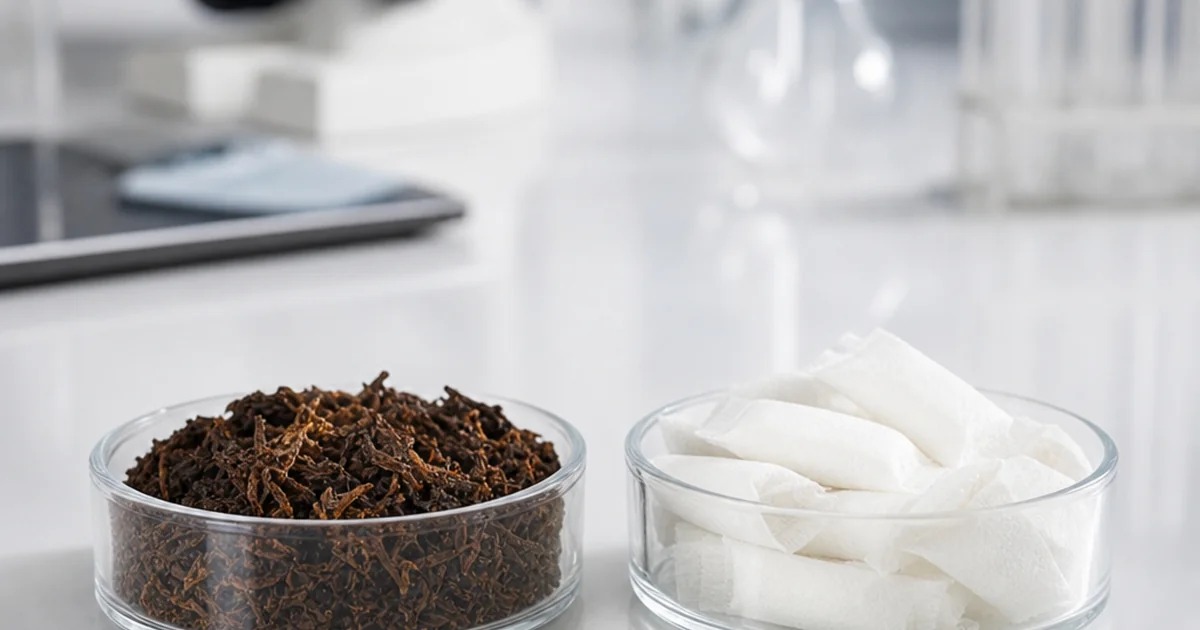
Nicotine pouches are less harmful than dip in measurable ways. They contain no tobacco leaf and negligible levels of tobacco-specific nitrosamines, the potent carcinogens abundant in cured tobacco. Research published in Tobacco Control found TSNAs in nicotine pouches at 13 ng NNN and 5.4 ng NNK per pouch, far lower than most cigarettes or traditional smokeless tobacco. If you are comparing the two products strictly on toxicant exposure, pouches win.
But here is the problem. Less harmful does not mean safe. And the "safer than" framing has become a psychological trap that keeps people addicted to nicotine for years longer than necessary.
What Makes Pouches Different From Dip
Dip, also called chewing tobacco or moist snuff, contains actual tobacco leaf. That leaf carries a cocktail of chemicals beyond just nicotine. When tobacco is cured and processed, it forms tobacco-specific nitrosamines, or TSNAs. These compounds are created when nicotine and other tobacco alkaloids react with nitrites during the curing process. TSNAs are among the most significant cancer risks associated with tobacco use.
According to VCU Health, individuals who dip or chew are exposed to at least 28 carcinogenic chemicals. Among these, TSNAs pose the most significant cancer risk. Studies show that dipping tobacco contributes to approximately 650,000 deaths globally each year.
Nicotine pouches take a different approach. They contain nicotine, plant fibers, flavorings, and sweeteners, but no actual tobacco leaf. Because there is no tobacco leaf, there is no curing process, and therefore no formation of TSNAs during manufacturing. Research confirms that TSNAs in nicotine pouches are either undetectable or present at negligible amounts.
This is a genuine reduction in risk. If you use two cans of dip per week, you are getting about the same amount of nicotine as 3.5 packs of cigarettes per day, plus all the tobacco-specific carcinogens. Switching to pouches eliminates that TSNA exposure.
The Cardiovascular Reality
Here is where the comparison gets more complicated. Nicotine, regardless of its source, affects your cardiovascular system. It triggers the release of adrenaline, which increases heart rate, blood pressure, and myocardial oxygen demand. With chronic exposure, resting heart rate remains significantly higher than in those who do not use nicotine.
The American Heart Association notes that nicotine increases blood pressure, heart rate, and blood flow to the heart while narrowing and hardening artery walls. This combination can lead to heart attacks over time.
Clinical research demonstrates that high-dose nicotine pouches can elicit acute cardiovascular responses, increased heart rate, blood pressure, and arterial stiffness, comparable in magnitude to smoking a cigarette. The European Society of Cardiology has stated that nicotine is not a harmless stimulant but a direct cardiovascular toxin.
So while pouches eliminate the cancer risks associated with tobacco leaf, they do not eliminate the cardiovascular risks associated with nicotine itself. Your heart and blood vessels do not care whether the nicotine came from a tobacco leaf or a synthetic source.
Oral Health: The Hidden Cost
Both products sit against your gum tissue for extended periods. Both can cause problems.
Dip is notorious for causing gum recession, tooth staining, and oral lesions. The tobacco leaf itself is abrasive, and the constant contact irritates soft tissue. Users often develop leukoplakia, white patches in the mouth that can be precancerous.
Nicotine pouches avoid the staining and abrasion from tobacco leaf, but they are not gentle on your gums. The physical pressure of the pouch against the gum line, combined with nicotine's vasoconstrictive effects, can reduce blood flow to gum tissue. Over time, this can contribute to gum recession.
Dental professionals report that frequent use of nicotine pouches can irritate the gums, leading to recession over time. Once gum tissue recedes, it does not grow back on its own. The exposed root becomes more vulnerable to sensitivity, decay, and further tissue loss.
So pouches may be gentler than dip in some ways, but they are not benign. The risk is lower, not absent.
The Addiction Trap
This is the core issue that the "safer than" conversation often misses. Both products deliver nicotine. Both create dependency. And dependency is the real harm that affects your daily life.
When you are addicted to nicotine, you structure your day around your next dose. You feel anxious when you cannot use. You spend money continuously. You hide your use from family or coworkers. The product controls you, regardless of whether it is dip or pouches.
The "harm reduction" framing suggests that switching from dip to pouches is a step toward quitting. Sometimes it is. But often it becomes a permanent parking spot. Users feel good about making a "healthier choice" and never take the next step to quit entirely.
Research confirms this pattern. There is no data showing nicotine pouches as a safe or effective way to quit. Medical experts do not recommend these products for smoking cessation. The risk is that users substitute one addiction for another without ever breaking free.
Why Safer Can Be Worse
It sounds counterintuitive, but the "safer" label can actually extend your addiction. Here is how.
When you used dip, you might have felt some guilt or concern about the health risks. That discomfort created motivation to quit. You knew dip was bad for you, and part of you wanted to be done with it.
When you switch to pouches, that discomfort fades. You tell yourself you made a smart choice. You feel relief. The motivation to quit evaporates because you believe you have solved the problem.
But you have not solved the problem. You have managed it. You are still addicted. You are still spending money. You are still structuring your life around nicotine. The only thing that changed is the packaging.
Years pass. Your pouch usage creeps up because they are discreet and easy to use anywhere. You are consuming more nicotine than you ever did with dip. And you are no closer to being free.
The Real Question
If you are comparing dip and pouches to decide which one to use, you are asking the wrong question. The question is not which product is safer. The question is whether you want to be addicted to nicotine for the rest of your life.
If the answer is no, then neither product is the right choice. Switching from dip to pouches is not quitting. It is relocating.
The only way to eliminate the risks, both the known ones and the unknown long-term effects, is to quit entirely. This is hard. Nicotine withdrawal is real. Cravings are intense. The habit is deeply wired into your daily routines.
But it is possible. Millions of people have quit dip, cigarettes, and nicotine pouches. The withdrawal lasts days to weeks. The freedom lasts a lifetime.
Making the Real Switch
If you are currently using dip and considering pouches, pause. Consider whether this is a step toward quitting or a way to avoid quitting.
If you are already using pouches and telling yourself it is harm reduction, be honest. Are you actually reducing your use over time? Or has your use stayed the same or increased? Are you any closer to being nicotine-free than you were when you started?
Harm reduction has a place in public health. For someone who will not quit tobacco entirely, switching to a lower-risk product is better than continuing with the higher-risk one. But harm reduction should be a bridge, not a destination.
The goal is not to find the safest way to use nicotine. The goal is to be free from nicotine entirely. That is the only option that eliminates all the risks, the known ones and the unknowns that research may reveal in coming years.
Related Articles
- The Real Dangers of Nicotine Pouches
- Long-Term Side Effects of Nicotine Pouches
- Zyn Withdrawal Symptoms: The Complete List
- What to Use Instead of Zyn: Alternatives That Actually Help
- How to Quit Zyn: The Complete 2026 Guide
Frequently Asked Questions
Is ZYN safer than chewing tobacco?
ZYN and other nicotine pouches are less harmful than chewing tobacco in measurable ways. They contain no tobacco leaf and negligible levels of tobacco-specific nitrosamines (TSNAs), the potent carcinogens found in cured tobacco. However, they still deliver nicotine, which raises blood pressure, increases heart rate, and creates addiction. Safer does not mean safe.
Do nicotine pouches cause cancer?
Nicotine pouches have not been on the market long enough for long-term cancer studies. They eliminate many tobacco-specific carcinogens found in dip and cigarettes, which reduces certain cancer risks. However, nicotine itself may promote tumor growth in existing cancers, and the long-term effects of pouch ingredients are still being studied. The cancer risk is likely lower than dip but not zero.
What are the real risks of nicotine pouches vs dip?
Compared to dip, nicotine pouches eliminate exposure to tobacco-specific nitrosamines and other carcinogens from tobacco leaf. However, both products carry risks from nicotine itself: cardiovascular effects (increased heart rate and blood pressure), gum recession from physical irritation and reduced blood flow, and severe addiction that affects daily life and finances.
Can you switch from dip to pouches to quit?
Switching from dip to pouches can be a harm reduction step, but it is not quitting. Research shows no data that nicotine pouches are an effective smoking or dip cessation tool. Many users end up addicted to pouches for years instead of quitting entirely. If your goal is to be nicotine-free, switching products delays that goal rather than achieving it.
Why do pouches feel safer but still feel addictive?
Pouches feel safer because they eliminate the visible signs of tobacco use: no spit, no stained teeth, no tobacco leaf, and no strong odor. They are discreet and socially acceptable. But they deliver the same addictive drug, nicotine, often in higher doses than dip. The addiction feels identical because it is identical. Your brain does not distinguish between nicotine sources.
Ready to quit nicotine entirely? Download PouchOut and start your journey to freedom today.