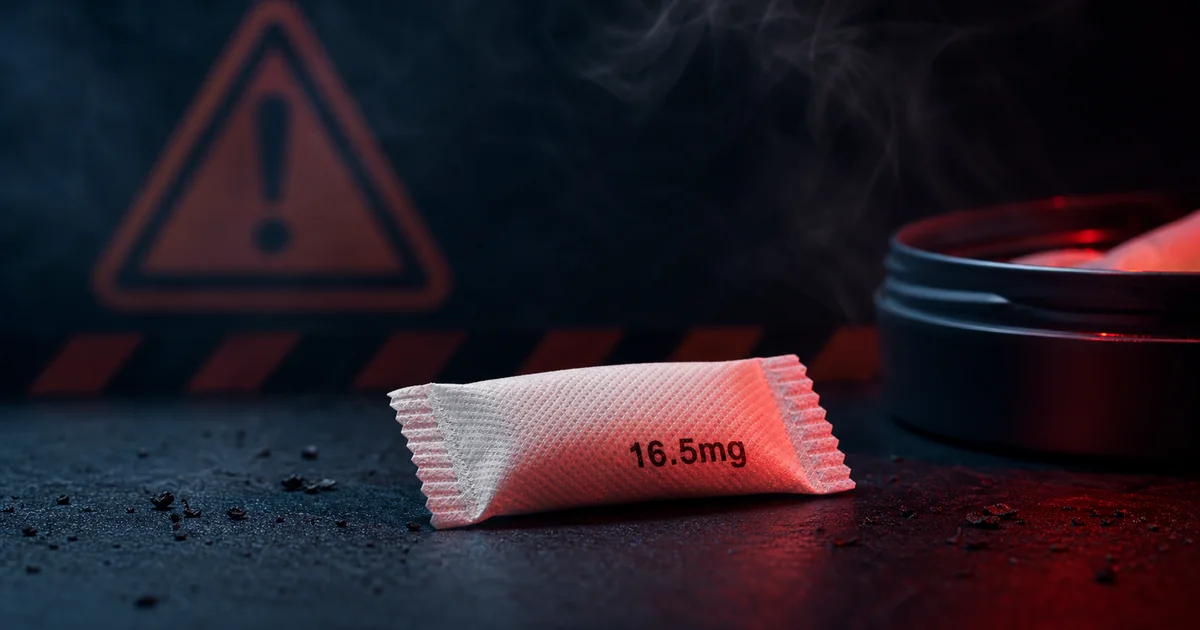
ZYN 16.5mg hit UK shelves in mid-2026, and the nicotine pouch world changed overnight. Philip Morris International calls it "meeting consumer demand." What they don't advertise is how this ultra-high strength rewires your tolerance faster than lower doses, locks in dependence harder, and makes the eventual quit more brutal than anything the 3mg or 6mg crowd faces.
This isn't fear-mongering. It's pharmacology. When you jump from 6mg to 16.5mg, you're not just getting "more of the same." You're crossing into territory where your brain's nicotinic receptors saturate more completely, withdrawal thresholds shift higher, and the psychological hooks dig deeper. I watched a friend switch from 6mg to 9mg "just for stressful days," then slide to 16.5mg within three months. Six months later, he couldn't get through a two-hour movie without a pouch. That trajectory isn't rare. It's predictable.
What 16.5mg Actually Means for Your Body
Most people don't think about nicotine strength numerically. They think about "buzz." Here's the problem: the buzz from 16.5mg isn't just stronger—it's different. At lower doses, nicotine triggers a sharp dopamine spike that fades relatively quickly. At 16.5mg, you're getting near-maximum receptor activation, which means the initial rush can feel overwhelming (nausea, dizziness, that "too much" feeling), followed by a longer, flatter plateau.
That plateau is where dependence forms. Your brain starts expecting that sustained activation. When you try to drop back to 6mg, it doesn't feel like "less buzz." It feels like something is missing. Something fundamental. That's not weakness. That's neurochemistry.
The physical side effects scale with strength too. Gum irritation that might be mild at 3mg becomes pronounced at 16.5mg. The tissue under your lip has a blood supply. High-concentration nicotine hitting that tissue repeatedly causes more vasoconstriction, more localized inflammation, more of the cellular stress that shows up as receding gums, mouth sores, and that persistent raw feeling experienced users know too well.
Why People Upgrade (And Why They Can't Downgrade)
The path to 16.5mg usually starts innocently. "My 6mg isn't hitting the same." "Work's been crazy, I need something stronger." "Everyone at the office uses the high-strength ones." These aren't excuses. They're real pressures that push people up the strength ladder one rung at a time.
Here's what the marketing leaves out: tolerance builds asymmetrically. Going up is easy. Your brain adapts within days. Going down is torture. Your brain has rewired itself around that higher activation level. A 6mg pouch, which once felt satisfying, now feels like nothing. So you either stay at 16.5mg forever, or you white-knuckle through a withdrawal that's proportionally worse than what light users experience.
I've talked to people who tried to quit 16.5mg cold turkey. The stories are remarkably consistent: day one feels manageable, day two brings crushing irritability, day three hits with physical symptoms—headaches, nausea, an inability to focus that makes work impossible. By day four, most have either caved or are white-knuckling through the worst of it. Compare that to 3mg quitters, who often describe their withdrawal as "annoying but manageable." The gap between those experiences is the hidden cost of high-strength nicotine.
The European vs. American Divide
American readers might be confused right now. "Wait, ZYN only goes up to 6mg here." Correct. The FDA authorized 20 ZYN products in January 2025, all capped at 6mg. European markets operate under different regulations, which is why 9mg, 11mg, and now 16.5mg variants exist across the Atlantic.
This regulatory gap creates a strange dynamic. American users who discover European ZYN through online vendors or travel often treat high-strength pouches as a premium product—something special, something "real." The reality is less glamorous. European regulators allow higher nicotine content because the framework evolved differently, not because 16.5mg is somehow safer or better engineered. It's just more.
There's also the practical matter of importation. American consumers buying 16.5mg ZYN online are operating in a gray area. Customs seizures happen. More importantly, you're self-administering a nicotine dose that no American physician would recommend starting with. The absence of regulatory oversight means no warning labels calibrated for that strength, no guidance on safe usage patterns, nothing to prevent someone from going through a can of 16.5mg pouches in a day and ending up in the ER with nicotine poisoning.
What 16.5mg Does to Your Quit Timeline
If you're reading this while using 16.5mg pouches and thinking about quitting, you need a different strategy than the standard advice. The withdrawal timeline scales with your daily nicotine intake, and 16.5mg users are consuming the equivalent of multiple packs of cigarettes worth of nicotine per day.
Week one will be the hardest. Not just psychologically—physiologically. Your brain has been swimming in high-concentration nicotine. Removing it creates a neurochemical crash that manifests as brain fog, emotional volatility, sleep disruption, and physical restlessness. The symptoms peak around day three to five, then gradually improve over the following week.
But here's the crucial part: the psychological dependence on high-strength nicotine runs deeper than physical withdrawal. You have to rebuild your capacity to handle stress, boredom, and social situations without that chemical support. That takes longer than detox. For 16.5mg users, I typically see the real turning point around week four—not week one, not week two, but that first month milestone when your brain has started producing its own dopamine again and life without pouches stops feeling like a constant sacrifice.
Harm Reduction vs. Harm Migration
Proponents of high-strength nicotine pouches often frame them as harm reduction. "At least it's not smoking." This is technically true. Nicotine pouches don't contain the tar, carbon monoxide, or combustion byproducts that make cigarettes so deadly. If a smoker switches to 16.5mg pouches, they've probably reduced their immediate health risks.
But harm reduction isn't the same as harm elimination, and there's a darker pattern here: harm migration. People who never smoked—never would have smoked—are starting with 16.5mg pouches because they're marketed as clean, modern, and socially acceptable. They're getting addicted to high-dose nicotine without ever having touched a cigarette. That's not harm reduction. That's creating a new generation of nicotine dependents who will eventually face the same quit struggles as smokers, just with different packaging.
The other migration pattern is from lower-strength pouches to higher ones. Someone who successfully quit smoking with 3mg ZYN gradually escalates to 6mg, then 9mg, then 16.5mg. Their original harm reduction victory gets eroded by increasing dependence. I've seen this story repeatedly: "I quit cigarettes, but now I'm more hooked on these than I ever was on smoking."
The Marketing Language You Should Ignore
PMI's communications around 16.5mg ZYN use specific phrases worth dissecting. "Best-in-class gross margins" appears in investor materials—not consumer warnings. "Significant growth potential" refers to revenue, not user wellbeing. "Meeting consumer demand" frames the product as responsive to market needs rather than actively creating those needs through availability.
The most insidious framing is "satisfaction." High-strength nicotine provides intense, immediate satisfaction because it floods your reward system. That satisfaction isn't free. It's borrowed against your future capacity to feel pleasure without chemical assistance. The more you borrow, the higher the interest rate.
When you see marketing that emphasizes "satisfaction" or "experience" without mentioning dependence, tolerance, or withdrawal, you're seeing incomplete information. Not false information—just the half that sells product.
Practical Steps for 16.5mg Users Who Want Out
If you're using 16.5mg and want to quit, standard advice won't cut it. You need an approach calibrated for high-dose dependence.
First, consider a taper rather than cold turkey. The jump from 16.5mg to zero is brutal. A stepped reduction—16.5mg to 11mg to 6mg to 3mg—spreads the withdrawal across weeks rather than concentrating it into days. Yes, this extends your timeline. It also increases your odds of success dramatically.
Second, plan for the cognitive hit. High-dose nicotine users experience more severe concentration problems during withdrawal than light users. Block out lighter work days if possible. Use the PouchOut app to track your progress and access guided craving management techniques designed specifically for nicotine pouch users.
Third, address the social component. If your workplace or friend group normalizes high-strength pouch use, you need strategies for those environments. Practice responses to offers. Have a non-nicotine alternative ready—gum, mints, something to occupy your mouth during the habitual moments.
Fourth, expect a longer timeline for feeling "normal." Three days might get you through acute withdrawal, but three weeks gets you through the worst of the psychological adjustment. Four weeks is when most high-dose quitters report feeling genuinely free. Plan your quit around that timeline, not the shorter ones you see in general nicotine cessation guides.
FAQ
Is 16.5mg ZYN available in the United States?
No. FDA authorization for ZYN products in the US is capped at 6mg. The 16.5mg variant is sold in European markets including the UK. American consumers who want high-strength pouches typically import them, which exists in a regulatory gray area and carries seizure risks at customs.
How does 16.5mg compare to cigarette nicotine?
A single 16.5mg pouch delivers more nicotine than a typical cigarette, though absorption rates differ. Cigarettes deliver nicotine faster through inhalation, creating a sharper spike. Pouches deliver nicotine more gradually through oral absorption. The total daily nicotine intake for someone using 10-15 pouches daily can exceed that of a pack-a-day smoker.
Can you overdose on 16.5mg ZYN?
Nicotine poisoning is possible with any strength if enough pouches are used in a short timeframe. Symptoms include nausea, vomiting, dizziness, rapid heartbeat, and in severe cases, seizures. The higher the strength, the fewer pouches required to reach dangerous levels. Using a full can (20 pouches) of 16.5mg in a day puts you in territory where adverse effects become likely.
Why do people switch to 16.5mg if it's harder to quit?
Most don't start with 16.5mg. They escalate from lower strengths as tolerance builds, often without realizing how dependence deepens at each step. By the time they recognize the problem, they're already locked into a high-dose pattern. Marketing that emphasizes "satisfaction" rather than dependence contributes to this escalation.
Is tapering from 16.5mg better than quitting cold turkey?
For high-dose users, tapering generally produces better outcomes than cold turkey, though it takes longer. The severity of withdrawal from 16.5mg can be intense enough to cause immediate relapse. A gradual reduction—16.5mg to 11mg to 6mg to 3mg—spreads withdrawal symptoms across weeks and allows your brain chemistry to adjust more gradually.
Will my gums heal after quitting 16.5mg ZYN?
Most oral tissue damage from nicotine pouches is reversible if caught early. Gum recession, irritation, and mouth sores typically improve within weeks of quitting. However, prolonged high-dose use can cause permanent gum recession that requires dental intervention. The sooner you quit, the better your recovery prospects.
How long does withdrawal from 16.5mg last?
Acute physical withdrawal peaks around days 3-5 and improves significantly by day 10. Psychological cravings and mood disruption can persist for 3-4 weeks. High-dose users often report that the "new normal" feeling—life without constantly thinking about nicotine—takes closer to a month to establish, compared to 1-2 weeks for lighter users.
Related Reading:
- How to quit ZYN without withdrawal symptoms
- ZYN gum recession and dental health
- Nicotine pouch withdrawal timeline day by day
- ZYN mouth sores and ulcers
- High strength nicotine pouches 9mg risks
- ZYN vs Velo vs On vs Lyft: easiest to quit
- Quit nicotine pouches app
- ZYN cost savings calculator
This article is for informational purposes and does not constitute medical advice. Consult a healthcare provider for personalized guidance on nicotine cessation.