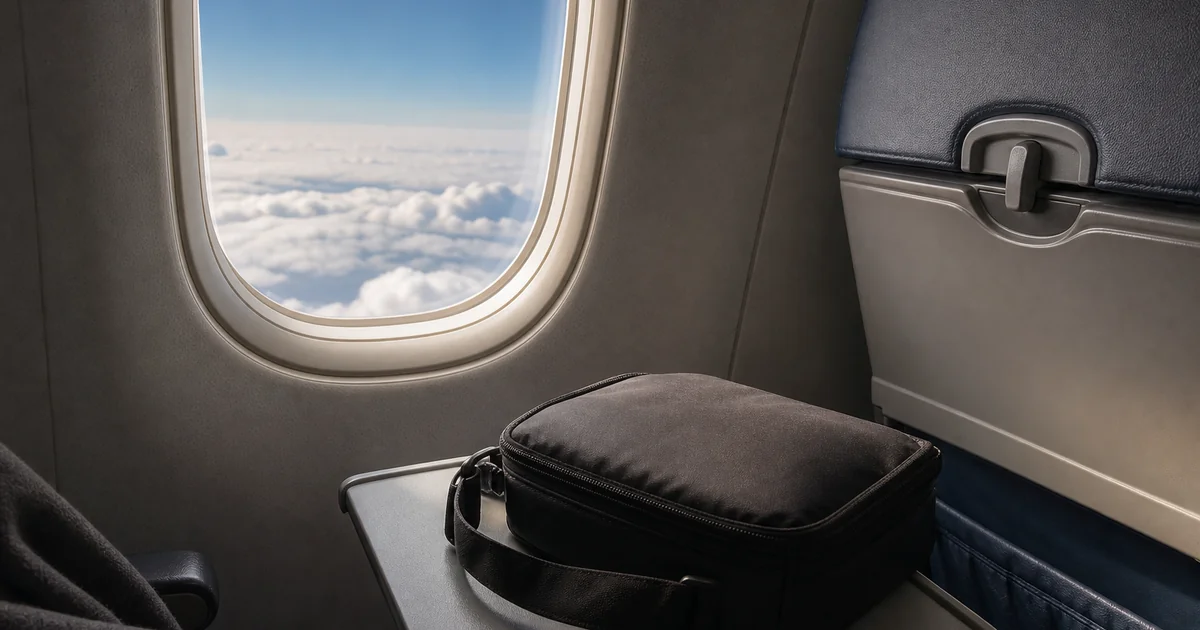
You are three hours into a transatlantic flight, somewhere over the Atlantic, and the seatbelt sign has been on for forty minutes. The captain keeps announcing "moderate turbulence ahead." Your travel pouch is in the overhead bin, three rows back, and your last ZYN went in right after the safety demonstration. That was four hours ago. You cannot reach your bag, you cannot use a pouch discreetly in your seat, and you are suddenly very aware of how long the remaining five hours will feel.
This scenario is more common than most people admit. Flying with nicotine pouches involves navigating TSA rules, airline policies, and the practical reality of being confined to a small seat for hours with limited access to your usual routine. Here is what you need to know about bringing ZYN on a plane, and how to handle the hours when you cannot use it.
What TSA Actually Says About Nicotine Pouches
The Transportation Security Administration does not list nicotine pouches as a restricted or special category item. You can pack them in your carry-on bag, your checked luggage, or both. There is no liquid restriction to worry about, no quantity limit for personal use, and no requirement to declare them at security screening.
That said, TSA officers have discretion to inspect any item that appears unusual on X-ray. A tin of white pouches in a bag might prompt a secondary screening, simply because it looks unfamiliar. If this happens, explain what it is calmly. Most officers have seen nicotine pouches before, and the interaction should be brief.
The bigger concern is your destination, not your departure. If you are flying internationally, the customs regulations of your arrival country matter more than TSA rules. Some countries have strict limits on nicotine products, require documentation, or ban certain strengths entirely. Check the specific rules for your destination before you pack. Do not assume that what is legal in the United States will be legal elsewhere.
Why Flights Are Uniquely Hard for Regular Users
Air travel was already difficult for nicotine users before pouches existed. Smokers knew the drill: use one right before security, endure the flight, find a smoking area immediately after landing. Pouches seemed like the perfect workaround. No smoke, no smell, no need to leave your seat. You could manage cravings discreetly at 35,000 feet.
Except you cannot, not really. Airlines require passengers to remain seated with seatbelts fastened during takeoff, landing, and whenever the seatbelt sign is illuminated. On long flights, this can add up to hours of enforced immobility. Even when the sign is off, the tight quarters of modern economy seating make discreet pouch use harder than it sounds. Your seatmate is inches away. The person behind you can see every movement. There is no privacy.
Then there is the dehydration factor. Cabin air is extremely dry, typically ten to twenty percent humidity. Nicotine is a mild diuretic, which means it contributes to fluid loss. The combination of dry air and nicotine can leave you feeling parched, headachey, and generally uncomfortable in ways that amplify withdrawal symptoms.
Practical Strategies for Long Flights
The key to managing a long flight as a nicotine pouch user is planning around the constraints, not fighting against them.
Bookend the flight with intentional use. Put in a fresh pouch right before you board, after you have cleared security and found your gate. This gives you a solid foundation for the pre-flight period and the initial climb to cruising altitude. Then, plan your next pouch for after you have landed and reached the terminal. This creates a defined window with a clear endpoint, which is psychologically easier than an open-ended deprivation.
Time use during meal service. The seatbelt sign is typically off during meal and beverage service, and cabin movement is expected. If you need a pouch mid-flight, this is your best window. Wait for the cart to pass, use the restroom, and handle your business quickly. Do not try to use a pouch at your seat. It is not worth the stress of worrying about who might notice.
Consider a lower strength option for travel days. If you normally use 6mg or 8mg pouches, pack a tin of 3mg or 4mg for the flight itself. The goal is not to eliminate nicotine entirely, but to smooth out the peaks and valleys. A lower strength pouch used strategically can prevent the all-or-nothing gap that makes long flights feel unbearable.
Hydrate aggressively. Drink water consistently throughout the flight, more than you think you need. Avoid alcohol and caffeine, both of which compound dehydration. Your body will handle nicotine fluctuations better if it is not also fighting dehydration.
The Accidental Tapering Test
Some users report that long flights, despite being uncomfortable, reveal something useful about their actual dependence level. When you are forced into an extended period without your usual nicotine intake, you get a preview of what withdrawal feels like in a controlled environment.
This is valuable information. If you make it through an eight-hour flight and the cravings are manageable, your dependence might be less severe than you assumed. If the experience is genuinely miserable, that is also useful data. It tells you where you stand and what a full quit attempt might involve.
The nicotine pouch withdrawal timeline breaks down what to expect hour by hour and day by day. Understanding the pattern helps you recognize that flight discomfort is temporary and follows a predictable arc. The first few hours are the hardest. Symptoms typically peak and then plateau.
Related Scenarios: Irregular Schedules and Disrupted Routines
Flight disruptions are just one example of how irregular schedules challenge nicotine routines. Our guide for ZYN and night shift work covers similar territory: how to manage cravings when your schedule does not follow a normal pattern, when sleep is disrupted, and when your usual cues and triggers are scrambled.
The principles overlap. Both situations require advance planning, alternative coping strategies, and realistic expectations about what your body will experience. If you can handle a long flight without your usual nicotine intake, you have evidence that you can handle other disruptions too.
Final Thoughts
Flying with ZYN is straightforward from a rules perspective. TSA allows it, airlines do not specifically prohibit possession, and the logistics are simple. The challenge is the reality of using nicotine products in an environment designed to keep you seated, still, and socially exposed for hours at a time.
Plan ahead. Use before boarding and after landing. Stay hydrated. Consider lower strength options for travel days. And pay attention to what the experience teaches you about your own patterns and dependence. A long flight is a temporary inconvenience, but it can also be a useful preview of what life without nicotine might feel like.
If you are thinking about quitting, the forced break of a long flight is a low-stakes opportunity to test your readiness. Download PouchOut before you travel, and use the flight as a practice run. You might be surprised by what you learn about yourself at 35,000 feet.