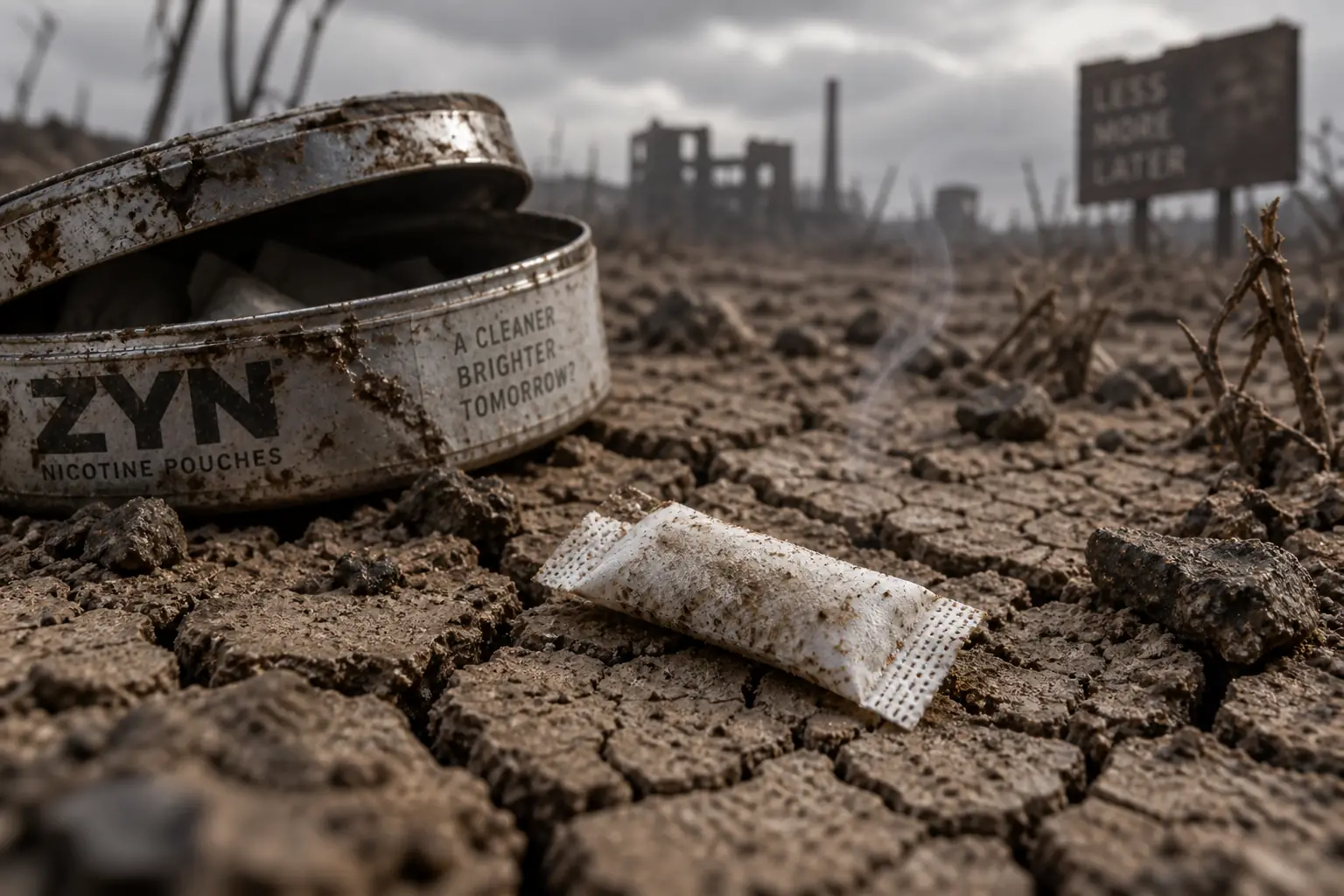
Nicotine pouches are marketed as a cleaner alternative to smoking, and in some ways they are. There is no secondhand smoke, no ash, no lingering odor on your clothes. But here is the part the ads do not mention: a daily ZYN user throws away roughly 15 to 20 small synthetic pouches every single day, plus a plastic or metal tin every week or two. Over a year, that adds up to thousands of individual pieces of waste. Most of it ends up in landfill. Some of it does not make it that far.
This post looks at what nicotine pouch waste actually is, why it is hard to dispose of responsibly, and what the growing pile of used pouches means for anyone trying to quit.
What ZYN Pouches Are Actually Made Of
The white pouch itself looks simple, almost like a tiny teabag. It is not paper. Most nicotine pouches use a nonwoven fabric made from cellulose fibers, often combined with synthetic binders to hold the shape. The filling is a mix of nicotine salt, plant fibers, flavorings, pH adjusters, and moisture agents. The can is typically polypropylene plastic with a metal lid, or in some cases entirely metal.
None of this breaks down quickly. The cellulose-based pouch material might degrade faster than pure plastic, but it is not compostable in any practical sense. The synthetic fibers and chemical residue mean it will sit in landfill for years. The tin is recyclable in theory, but most curbside programs do not accept small mixed-material containers, so they go in the trash.
The Scale of the Waste Problem
A single can of ZYN holds 15 pouches. Someone using one can per day discards 5,475 pouches annually. If they go through two cans, that is nearly 11,000 pouches. Each one is a small piece of synthetic material laced with nicotine residue.
Empty tins accumulate too. Even if a user reuses a few for storage, most end up discarded. Multiply this across millions of users, and the volume becomes significant. Nicotine pouches are one of the fastest-growing tobacco categories in the United States, and the waste stream is growing with it.
There is no industry-wide take-back program. There is no standardized recycling guidance on the packaging. Users are left to figure it out themselves, and most do not try.
Why Proper Disposal Matters
Used nicotine pouches contain residual nicotine. When thrown in regular trash, that nicotine can leach into soil and groundwater as the waste decomposes. The amounts from individual pouches are small, but the cumulative effect across millions of discarded pouches is not zero.
There is also the litter problem. Pouches are small and easy to drop. Empty tins get left in cars, desks, and public spaces. Unlike cigarette butts, which are immediately recognizable as litter, a small white pouch on the ground is easy to miss. But it is still there.
For pet owners, used pouches are a poisoning risk. Dogs are attracted to the sweet flavors, and even a single used pouch can contain enough residual nicotine to make a small dog seriously ill. This is not theoretical. Veterinary poison control centers report nicotine pouch ingestion cases regularly.
Can You Recycle ZYN Tins?
The short answer is: usually not through curbside recycling. Most ZYN tins are made from polypropylene, which is technically recyclable, but the small size and mixed materials (plastic body, metal lid, sometimes a paper label) make them incompatible with standard sorting equipment. They fall through screens or get rejected as contamination.
Some users clean and repurpose tins for small items like pills, earbuds, or screws. Others collect them for craft projects. These are fine personal solutions, but they do not address the systemic problem.
A few specialized recycling programs accept small rigid plastics, but they are not widely available. TerraCycle has run niche collection programs for tobacco waste in the past, but nothing currently exists specifically for nicotine pouch containers at scale.
The Biodegradability Myth
Some users assume that because the pouch looks like paper or cotton, it must biodegrade. This is not true. The nonwoven fabric is engineered for moisture resistance and structural integrity. It needs to hold together in a wet mouth for up to an hour. Those same properties make it resistant to breaking down in soil or compost.
Even if the cellulose component eventually degrades, the synthetic binders and nicotine residue remain. A used pouch is not organic waste. It should not go in compost, and it will not disappear if buried or flushed.
Flushing nicotine pouches is a particularly bad idea. They do not break down in water and can contribute to pipe blockages and water treatment contamination. The packaging explicitly warns against this, but some users do it anyway.
What Responsible Disposal Looks Like
The safest option is to seal used pouches in a bag and place them in household trash. This at least contains the nicotine residue and prevents accidental ingestion by children or pets. Empty tins should also go in the trash unless you have access to a specialized recycling program that accepts them.
Some harm reduction organizations recommend mixing used pouches with coffee grounds or cat litter before disposal. The idea is to make them unappealing to animals and children. This is a reasonable extra step if you have pets or young children in the home.
The only genuinely sustainable solution is to stop generating the waste in the first place. Every pouch not used is one less piece of synthetic material in landfill.
How the Waste Pile Becomes a Quitting Motivator
For some users, the environmental guilt becomes part of the quitting story. They start noticing the accumulation. The drawer full of empty tins. The trash bag that smells minty. The moment they realize they have thrown away thousands of these things.
One user described keeping a glass jar of used pouches on his desk as a visual reminder. The jar filled in three weeks. He said it was the most effective anti-craving tool he tried.
Another described finding a used pouch on the beach during a vacation. She had been telling herself that her habit was harmless, that at least she was not smoking. The pouch on the sand made her reconsider.
These are not environmental crusaders. They are regular people who reached a point where the waste became impossible to ignore.
The Industry's Silence
Nicotine pouch manufacturers do not prominently address waste on their packaging or websites. The focus is on harm reduction relative to smoking, which is a valid point but not the whole story. A product that positions itself as cleaner should probably have a clearer plan for what happens after the product is used.
Some brands have experimented with biodegradable pouch materials, but nothing has reached mainstream production. Others have explored take-back programs, but none have scaled. The default remains: use it, toss it, forget it.
Comparing Waste Streams
Cigarettes remain the worst environmental offender in tobacco. Butt litter is the most common form of ocean plastic pollution, and cigarette manufacturing involves deforestation and heavy pesticide use. Nicotine pouches are less destructive on those fronts.
However, the comparison only goes so far. Pouches replace one waste stream with another. They eliminate smoke but create a synthetic fiber problem that did not exist at this scale before. The environmental trade-off is real, and users deserve to know about it.
Practical Steps for Current Users
If you are not ready to quit, there are still ways to reduce the waste footprint:
- Reuse tins for storage instead of discarding them
- Keep a sealed container for used pouches to prevent nicotine leaching and pet exposure
- Do not flush pouches or leave them in public spaces
- Consider whether lower-frequency use is possible
These are partial measures. They do not solve the problem, but they reduce the harm while you work toward quitting.
How PouchOut Helps You Track the Waste
The PouchOut app includes a usage tracker that shows your cumulative consumption over time. Many users report that seeing the numbers, day after day, is what finally motivated them to cut back or quit entirely.
The app also includes craving management tools, progress milestones, and community support. If the environmental impact of your habit has started to bother you, tracking your usage is a concrete first step toward doing something about it.
Download PouchOut today and see your consumption in numbers that are hard to ignore.
Frequently Asked Questions
Are ZYN pouches biodegradable?
No. The pouch material contains synthetic fibers and binders that do not break down in compost or soil. Residual nicotine also makes them unsuitable for organic waste disposal.
Can I recycle empty ZYN tins?
Most curbside recycling programs do not accept them due to their small size and mixed materials. Check with your local waste authority, but expect the answer to be no.
Is it safe to throw used pouches in regular trash?
It is the safest available option. Seal them in a bag to contain nicotine residue and prevent accidental ingestion by pets or children.
What happens if a dog eats a used nicotine pouch?
Contact a veterinarian or poison control immediately. Even used pouches can contain enough residual nicotine to cause vomiting, tremors, seizures, or worse in small dogs.
Are there any eco-friendly nicotine pouch alternatives?
Not at mainstream scale. Some brands have experimented with biodegradable materials, but most products on the market use the same synthetic pouch construction.
Does the nicotine in discarded pouches harm the environment?
Nicotine is toxic to aquatic life and can leach into soil and groundwater from landfill. The environmental impact from individual pouches is small, but the cumulative effect across millions of discarded pouches is not negligible.
How many pouches does the average user discard per year?
A one-can-per-day user discards approximately 5,475 pouches annually. At two cans per day, the number approaches 11,000.
Can I compost used nicotine pouches?
No. The synthetic materials and nicotine residue make them unsuitable for composting.
Related Reading
- ZYN ingredients breakdown
- How to quit ZYN
- Nicotine pouch side effects
- ZYN vs smoking
- Reasons to quit ZYN
- Quitting ZYN without withdrawal
- ZYN cost savings calculator
- ZYN and oral health
Ready to reduce your impact? Download PouchOut and start tracking today.