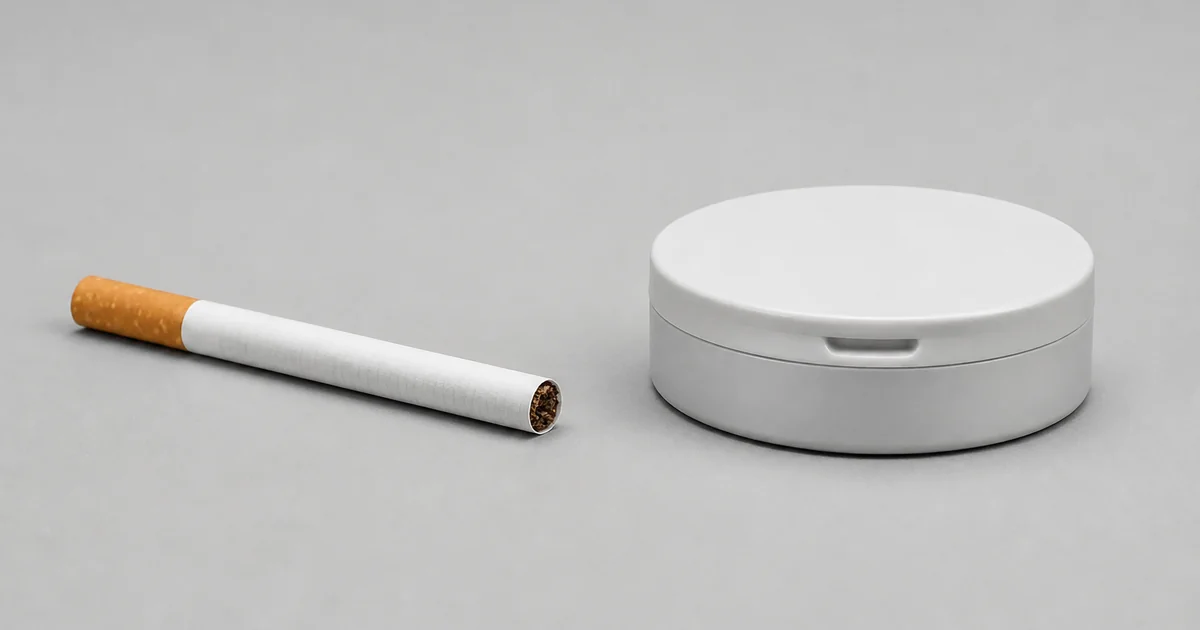
You are trying to switch from smoking to pouches, or maybe you are just curious about what you are actually consuming. You type a simple question into a search engine: how many cigarettes equal one ZYN pouch? You expect a straightforward number, something you can use to compare your old habit to your new one. Instead, you find chaos. One website claims a single pouch equals one-third of a cigarette. Another says it equals one full cigarette. A third source insists it is closer to two or three. You close the tabs more confused than when you started, wondering why something so simple has no clear answer.
The reason every source gives a different number is that no single correct conversion exists. Cigarettes and nicotine pouches deliver nicotine through completely different absorption pathways: inhaled combustion versus slow oral absorption through gum tissue. These two methods are not directly comparable in a simple ratio. Individual physiology, smoking style, and pouch usage habits all create wide variation in how much nicotine actually reaches the bloodstream. Most estimates fall somewhere between less than one cigarette and a few cigarettes per pouch depending on strength, but any single number is already an oversimplification.
Why There Is No Single Correct Conversion
The fundamental problem with the cigarette-to-pouch comparison is that it assumes two things are equivalent when they are not. A cigarette delivers nicotine through combustion and inhalation. The nicotine travels through the lungs into the bloodstream almost instantly, creating a rapid spike. A pouch delivers nicotine through the mucous membranes in your mouth. The nicotine seeps gradually into your bloodstream over the course of minutes, creating a slower, more sustained curve.
These are not just different speeds. They are different pharmacological experiences. The rapid spike from a cigarette creates a different subjective effect than the gradual rise from a pouch. Your brain processes these differently. The craving satisfaction, the duration of effect, and the withdrawal patterns all differ between the two methods.
When someone asks how many cigarettes equal one pouch, they are asking for a conversion between apples and oranges. Both contain nicotine, but the way that nicotine is delivered, absorbed, and experienced is so different that a simple numerical ratio cannot capture the reality. This is why sources contradict each other so wildly. Each one is trying to force a comparison that does not naturally exist.
Why Absorption Efficiency Differs So Much
Not all the nicotine listed on a product label actually makes it into your bloodstream. This is true for both cigarettes and pouches, and the percentage that gets absorbed varies enormously based on individual factors and usage patterns.
With cigarettes, absorption depends on how deeply you inhale, how long you hold the smoke, and how frequently you puff. A light smoker who takes shallow puffs absorbs far less nicotine from the same cigarette than a heavy smoker who inhales deeply and holds the smoke. The cigarette might contain the same total nicotine, but the delivered dose varies by person and by smoking style.
With pouches, absorption depends on how long you keep the pouch in place, how much saliva contacts it, and the specific physiology of your gum tissue. Someone who removes a pouch after ten minutes absorbs less than someone who keeps it in for the full recommended time. Someone with more vascular gum tissue absorbs faster than someone with less. The pouch contains a fixed amount of nicotine, but your body does not absorb all of it, and the percentage varies.
This variation in absorption efficiency is the core reason online estimates differ so widely. One source might assume high absorption rates for both products. Another might assume low rates. A third might use average figures that do not match your personal physiology. None of them are necessarily wrong. They are just making different assumptions about absorption, and those assumptions dramatically change the resulting ratio.
Why Individual Factors Make a Fixed Ratio Meaningless
Even if you could standardize absorption efficiency, individual variation would still make any single conversion number misleading. A light smoker and a heavy smoker do not experience the same nicotine load from one cigarette. Someone who smokes five cigarettes a day has a different tolerance and baseline than someone who smokes twenty. The same cigarette delivers a different subjective effect to each person.
Similarly, pouch users differ in how they use the product. Someone who holds a pouch the full recommended time absorbs more nicotine than someone who removes it early because the flavor fades or because they get impatient. Someone who uses pouches continuously throughout the day maintains a higher baseline nicotine level than someone who spaces them out. These usage patterns change the effective dose without changing the product itself.
Any single conversion number is already an oversimplification before you even factor in pouch strength. A 3mg pouch and a 6mg pouch obviously deliver different amounts of nicotine, but the difference is not linear because absorption curves and individual tolerance also play roles. A heavy smoker might find a 3mg pouch unsatisfying while a light smoker finds a 6mg pouch overwhelming, regardless of what the math suggests.
What a Reasonable Range Actually Looks Like
Given all these variables, what can you actually know? You can know that most estimates fall somewhere between less than one cigarette and a few cigarettes per pouch depending on strength and individual factors. This is not a satisfyingly precise answer, but it is an honest one.
A 3mg pouch, for most users, likely delivers less nicotine than a typical cigarette smoked in a typical way. A 6mg pouch might deliver roughly comparable nicotine, or perhaps slightly more, depending on how it is used. Higher strength pouches can deliver nicotine loads that exceed a single cigarette for many users. But these are rough ranges, not definitive facts.
The honest way to present this information is as a spectrum with wide variation, not as a single number. Anyone who tells you definitively that one pouch equals exactly X cigarettes is either oversimplifying or making assumptions that may not apply to you. The real answer is that it depends, and the factors it depends on are numerous and personal.
Why This Matters Practically
If you are switching from smoking to pouches, the goal should not be finding the exact mathematical equivalent. The goal should be finding a strength and usage pattern that feels comparable to your personal smoking habits and adjusting based on actual experience rather than a formula.
Start with a pouch strength that seems reasonable based on your smoking history. If you were a light smoker, start lower. If you were a heavy smoker, you might need a higher strength to feel satisfied. Pay attention to how you feel. Are you craving constantly? You might need a higher strength or more frequent use. Are you feeling jittery or nauseous? You might be using too high a strength or using too frequently.
The adjustment process is personal and empirical. No conversion chart can tell you what will work for your specific body and habits. You have to experiment, observe, and adjust. The question is not how many cigarettes equal one pouch. The question is what pouch strength and usage pattern keeps you satisfied without making you feel unwell.
The Bottom Line
The contradictory answers you find online about cigarette-to-pouch conversion are not evidence that some sources are wrong and others are right. They are evidence that the question itself is flawed. Cigarettes and nicotine pouches deliver nicotine through fundamentally different pathways that cannot be reduced to a simple ratio. Absorption efficiency varies by individual. Usage patterns change the effective dose. Any single number is an oversimplification.
What you can know is that most estimates fall in a broad range, and your personal experience will depend on factors no chart can predict. The practical approach is to start with an educated guess based on your smoking history, then adjust based on how you actually feel. The math is less important than your own body's feedback.
For more on choosing the right nicotine strength for your situation, see our guide on nicotine pouch strength. If you are comparing pouches to smoking from a health perspective, see our post on ZYN versus smoking. If you are ready to quit nicotine entirely, download PouchOut for structured support, progress tracking, and a proven path to becoming nicotine-free.